BIFROST — Where Every Event Becomes
a Verifiable System Action
Deterministic event orchestration for AI systems.
No duplication. No hidden state. No ambiguity.
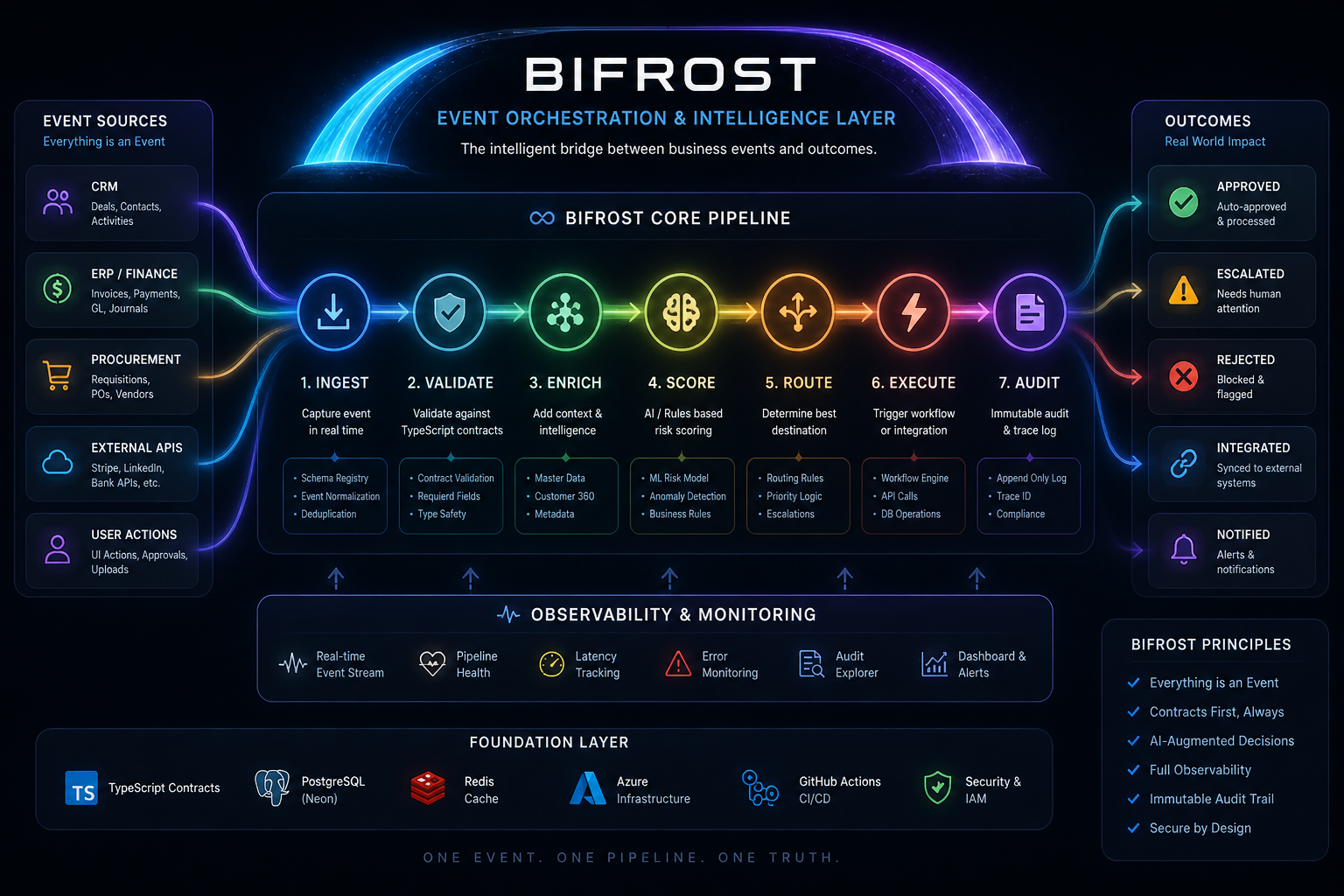
Orchestration Model
Bifrost uses event-driven sequential pipelines.
Each service consumes and emits typed events.
No direct service-to-service calls.
No shared mutable state.
All state changes occur through events.
No service can mutate global state. All state changes occur through events only.
The Event Contract
Every event in Bifrost must conform to this exact schema. No exceptions.
{
  "id": "evt_7f3a9c2b",
  "type": "invoice.created",
  "timestamp": "2026-04-29T14:23:01.000Z",
  "source": "crm/opportunities",
  "payload": {
    "client": "Nova Corp",
    "amount": 12500,
    "currency": "USD"
  },
  "metadata": {
    "trace_id": "sk-7f3a9c2b-x9k2",
    "version": "v1",
    "schema_version": "1.0.0",
    "idempotency_key": "inv_novacorp_20260429"
  }
}
Schema Versioning Strategy
- v1 (current) → All fields above required
- v2 (planned) → Adds enrichment metadata
- Backward compatibility: v1 events always valid in v2
Rule: "New versions never break old contracts. Old events are always processable."
Determinism Guarantee
If you run the same event twice — the system produces the same result.
Bifrost enforces idempotency via event IDs. Duplicate events are detected via idempotency_key and ignored or reconciled.
Every event ID is unique. Every outcome is traceable. Same input always produces same audit trail.
// Duplicate detection
const existing = await prisma.bifrostEvent.findFirst({
  where: {
    payload: { path: ['metadata', 'idempotency_key'],
    equals: event.metadata.idempotency_key }
  }
})
if (existing) return {
  status: 'duplicate_ignored',
  original: existing.id
}
5 Services. One Responsibility Each.
No god objects. No hidden complexity.
SERVICE 1: Event Intake Service
Responsibility: "Receives raw events and persists them before any processing begins."
Input/Output
type Input = RawBifrostEvent
type Output = PersistedEvent
Code
export async function ingest(e) {
  return prisma.bifrostEvent.create({ ... })
}
FAILURE BEHAVIOR
"On failure → returns INTAKE_FAILED error. Event is never lost — retry queue activated. Pipeline halts. No partial processing."
SERVICE 2: Contract Validation Service
Responsibility: "Validates every event against the TypeScript contract. Rejects non-compliant events."
Input/Output
type Input = PersistedEvent
type Output = ValidatedEvent | Error
Code
export function validate(e) {
  const res = validateSchema(e)
  return res.valid ? e : res.err
}
FAILURE BEHAVIOR
"On failure → emits EVENT_VALIDATION_FAILED. Pipeline halts immediately. Error logged to observability layer. Caller receives violation list."
SERVICE 3: Risk Scoring Service
Responsibility: "Calculates risk score 0-100 using rules engine and ML fallback."
Input/Output
type Input = ValidatedEvent
type Output = ScoredEvent
Code
export async function score(e) {
  const ml = await scoreWithML(e)
  return { ...e, score: ml ?? rules(e) }
}
FAILURE BEHAVIOR
"ML service failure → automatic fallback to TypeScript rules engine. Score is never null. Pipeline never halts due to scoring failure."
SERVICE 4: Routing Service
Responsibility: "Determines the correct destination and action for each event."
Input/Output
type Input = ScoredEvent
type Output = RoutedEvent
Code
export function route(e) {
  const res = routingRules.eval(e)
  return { ...e, destination: res }
}
FAILURE BEHAVIOR
"On failure → routes to DEFAULT_REVIEW queue. No event is dropped. Human review triggered automatically."
SERVICE 5: Audit Service
Responsibility: "Creates an immutable, append-only audit record for every event."
Input/Output
type Input = ProcessedEvent
type Output = AuditRecord
Code
export async function audit(e) {
  return prisma.auditLog.create({ ... })
}
FAILURE BEHAVIOR
"Audit is the LAST stage. It never blocks. If audit write fails → emergency log to separate append-only store. Audit failure is a P0 alert. No audit = system violation."
6 Principles. All Enforceable.
Not philosophy. Engineering requirements.
Verify It Yourself
Live Demo Terminal
Watch the Bifrost pipeline execute in real-time. Select an event type and see deterministic processing.
ONE EVENT. ONE PIPELINE. ONE TRUTH.
No duplication. No hidden state. No ambiguity.